


 님
님
 내 쑥쑥트리
 쪽지
쪽지 내글
내글 스크랩
스크랩 내댓글
내댓글 북클럽
북클럽 날따방
날따방 모임터
모임터 쑥쑥몰
쑥쑥몰
 체험이벤트
체험이벤트


 로그아웃
로그아웃 PC버전
PC버전



강의실

쇼핑몰

공연
컨텐츠
- Erin37
- |
- 2013-01-11 21:01
Q1.
The speed, the amplitude, and the depth of the water are connected. The amplitude stands for the energy a wave is carrying, and the energy shrinks when the depth of the water decreases, and so does the speed. So the amplitude and the speed will decrease when the depth decreases. However, the wavelength of the wave is not influenced by the depth. So, when the depth of the water decreases, the amplitude and the speed will decrease, while the wavelength does not change.
Q2.
To get the speed of the waves, you have to multiply the wavelength and the frequency of the waves. If you multiply 1 and 0.5, you get 0.5. So you get that the speed of the waves is 0.5m/sec. To get how many meters the waves travel in 4 seconds, you have to multiply the speed and the time. If you multiply 0.5 and 4, you get two.
So the particle of the water will be two meters away in 4 seconds.
- annie0717
- |
- 2013-01-06 11:30
1.When the depth of the water decreses, the wave will have less energy. Amplitude is the measurement of the energy of a wave, thus the amplitude of the wave will decrease as well. On the other hand, wavelength, which calculates the distance between one wave crest or trough to the next, and speed(frequency), which is the number of waves passing a fixed point in a certain amount of time, does not have anything to do with the depth of a wave. To sum up, the amplitude decreases when the depth of the water decreases, while the wavelength and speed of the wave is not influenced by it.
2. Wavelength=1m, Frequency=0.5times/sec
Speed=1m*0.5=0.5(m/s)
0.5*4=2.
Thus, a particle of water will be two meters away in four seconds.
- directioner
- |
- 2013-01-04 20:42
Name: Daresa Lee(My korea name is Ga-Hyun Lee)
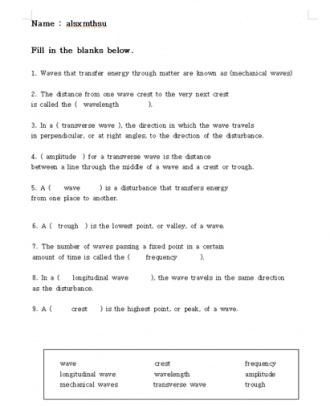
1. Waves that transfer energy through matter are known as (mechanical waves).--Page 11
2. The distance from one wave crest to the very next crest is called the (wave length.)--Page 17
3. In a (transverse wave), the direction in which the wave travels in perpendicular, or at right angles, to the direction of the disturbance--Page 13
4. Amplitue for a transverse wave is the distance between a line through the middle of a wave and a crest or trough.--Page 17
5. A (wave) is a disturbance that trasnfers energy from one place to another.--Page 9
6. A (trough) is the lowest point, or valley, of a wave.--Page 17
7. The number of waves passing a fixed point in a certain amount of time is called the (frequency).--Page 17
8. In a (longitudinal wave), the wave travels in th same direction as the disturbance.--Page 14
9. A (crest) is the highest point, or peak, of a wave.--Page 17
- directioner
- |
- 2013-01-04 20:28
Answer 1:
Amplitude indicate how much energy a wave is carrying. So that means when the depth of the water decreases, the amplitude will decreases, too. How about the wave length? The wave length is a distance from one wave crest to the very next crest. And it has nothing to do with amplitude. So if the depth of the water decreases, the amplitude will decreases too, and the wave legth and spedd of the wave will be not be changed.
Answer 2:
Wave length=1m, frequency=0.5 times/sec.
1 * 0.5=0.5 So, the speed of the wave is 0.5m/s.
0.5 times 4 is 2, so the answer to question 2 will be Two Meters.
- 빛나는지
- |
- 2013-01-02 20:20
answer to Q1. When the depth of the water decreases, the energy that the wave is carrying will decrease, and the amplitude will become smaller. Meanwhile, the wavelength, the frequency, and the speed that has nothing to do with the amplitude will not change.
answer to Q2. A water particle would move 2m away in 4 seconds.
- 엔젤킴
- |
- 2013-01-01 16:16
A 1) When predicting how the wave will feature when the depth of the water decrease, the 3 main factors of a wave; amplitude, wavelength, and frequency should be thought of. Because amplitude and the depth of a water is directly proportional, the amplitude of a wave will decrease as the depth of the water decreases. However, a wave's wavelength and frequency has no relationship with the depth of the wave. Therefore, the wavelength and frequency will stay the same.
A 2) In 4 seconds a particle of water will be 2m away.
- 엔젤킴
- |
- 2013-01-01 15:49
Name: Jiwoo Kim
1. mechanical waves
2. wave length
3. transverse wave
4. Amplitude
5. wave
6. trough
7. frequency
8. longitudinal wave
9. crest
- alsxmthsu
- |
- 2012-12-27 22:27
A1)When the depth of the water decrease there are somethings that will change and what they don't. Amplitude has relationship with depth so as water depth decreases, amplitude decreases as well. However, wavelength and speed of the waves has none of it so it stays the same.
A2) I's wavelength is 1m and frequency is 0.5 times/sec so in seconds two meters will pass away.
→8
- 날아라상윤
- |
- 2012-12-27 17:58
책 값이 너무 비싸요.ㅠㅠ